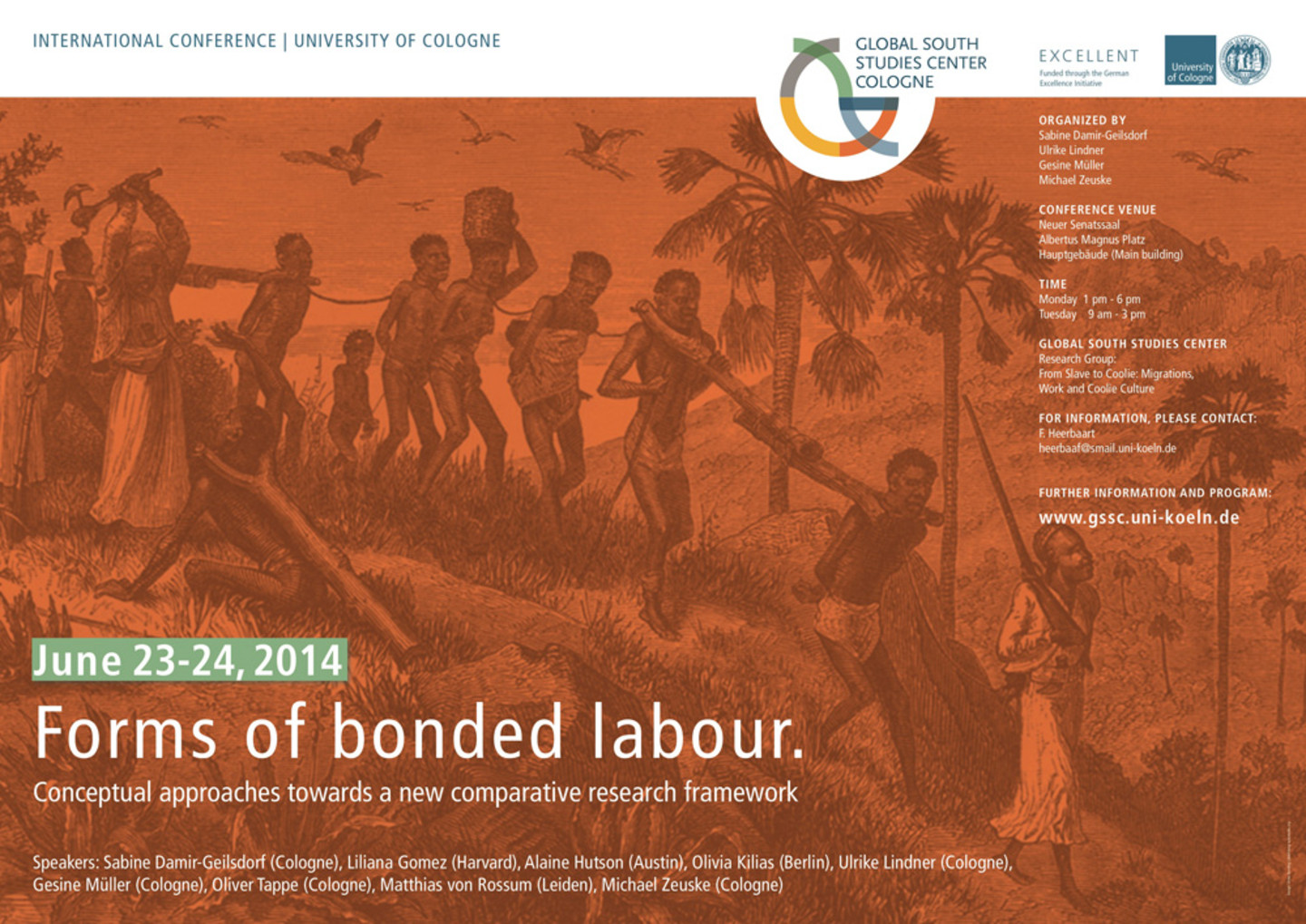
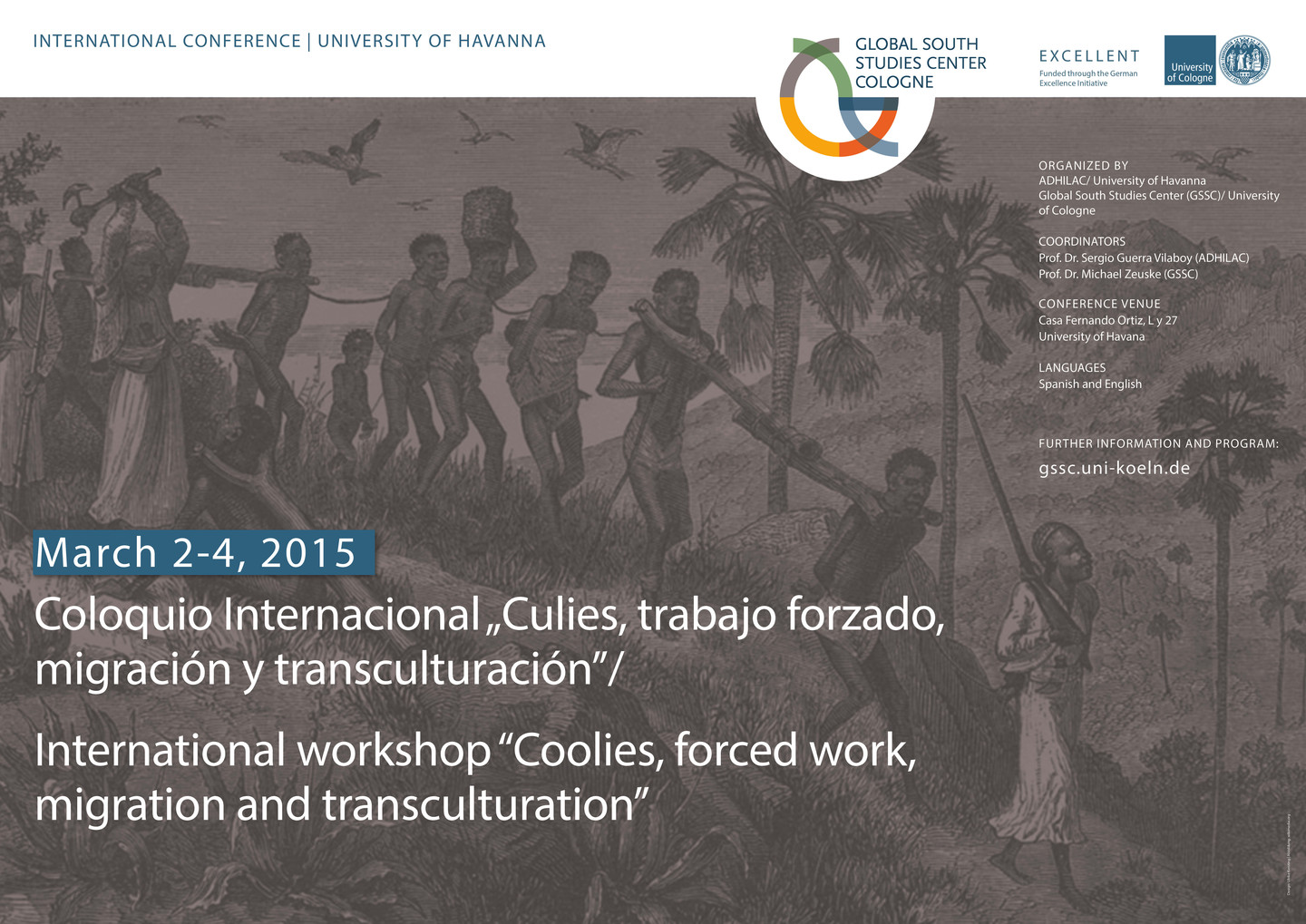
Coolie and indentured labour are specific forms of unfree labour located between slavery and wage labour. This thematic group will engage in a new, interdisciplinary analysis of colonial and neocolonial variants of contract labour. Bridging history, cultural studies, gender studies, and ethnographic and social science approaches, it seeks to trace the multiple dimensions of and linkages between historical and contemporary processes of transculturation and creolization brought about through contract labour by Asian migrants, often called coolies. After four centuries of creolizations based on Indian forced workers and black slaves, the world-wide phenomenon of coolie labour began to spread during the second half of the 19th century through the Americas, Africa, and Arab countries, and sometimes Europe. Following a long period of abolitionist measures during the 19th century, new workers were needed for labour-intensive economies, now under the requirements of free trade and an evolving world economy. Contract labour developed as a new organizational form in order to allow the “import” of coolies into regions of the world with a demand for labour. The colonial powers of the 19th century identified a pool of male and female workers within the overpopulated areas of India, Indonesia and China with easy recruitment potential. After 1880, most European empires also became engaged in the scramble for Africa and needed cheap workers for the exploitation of African resources during the next decades. The British Empire developed into the most important coolie-trader worldwide and brought a growing number of indentured Asian workers to the Caribbean, as well as to plantations and mines in South Africa and other countries. In French Indochina, coolie labour constituted a keystone of the colonial mise en valeur policy, bringing about demographic shifts and sociocultural transformations. Less known is the fact that other colonial powers, such as the Spanish, Portuguese, and German colonial empire, were also involved in the coolie trade and brought indentured workers to their own Caribbean, Spanish American, Brazilian, African and South Asian colonies. Altogether, around one million Indian contract labourers and many millions of Chinese workers became part of coolie migration. At the same time, local slavery and the slave trade were still prevalent.
Similar forms of work organization and migration can be found even today, particularly in the Arab world. Since the 1970s in the Arab Gulf States South Asian migrant workers have formed a growing sector of the work force, and in some countries today even the clear majority of the population. Through sponsorship systems migrant workers are closely tied to their employers, who assume full economic and legal responsibility for them during their contract period. Without the specific approval of the sponsors (employers), who sometimes illegally hold their employees’ passports, workers cannot enter or leave the country or move to another employer. For low-skilled workers, especially domestic workers who do not fall under the labour law, this had led to forms of deceptive recruitment, debt bondage labour or illegal visa trading.
In recent works of cultural studies the question of coolies has gained new attention as an important dimension in the reorganization of ethnic boundaries in many countries worldwide. As latecomers to creolization, Asian coolies became an indicator of racial dislocations and demarcations; they had e.g. to endure xenophobia from both whites and blacks when arriving in the Caribbean. A new approach was taken up by the poet and cultural critic Khal Torabully, from Mauritius, who opened the discussion in the 1990s for the understanding of the pluricultural configurations and identités composites of the Caribbean. He further developed and refined Franco-Caribbean models of different creolities. His concept of coolitude integrates the ethnic complexity of post-abolitionist societies and is not bound to territorial belonging or ethnic origin, but to the economic and legal situation of the coolies.
The concept of coolitude will help us to develop a new approach to coolie culture worldwide and across time, but first of all, it enhances our understanding of the changing spaces of creolizations and – on a more general scale – of cultural dynamics in the Global South. Graded rights and politics of exclusion are other key aspects of indentured labour contracts that affect both social relations and individual subjectivities. The long-term perspective on coolie labour and processes of creolization will open up new perspectives on labour relations in the Global South and the corresponding dynamics of sociocultural change.